
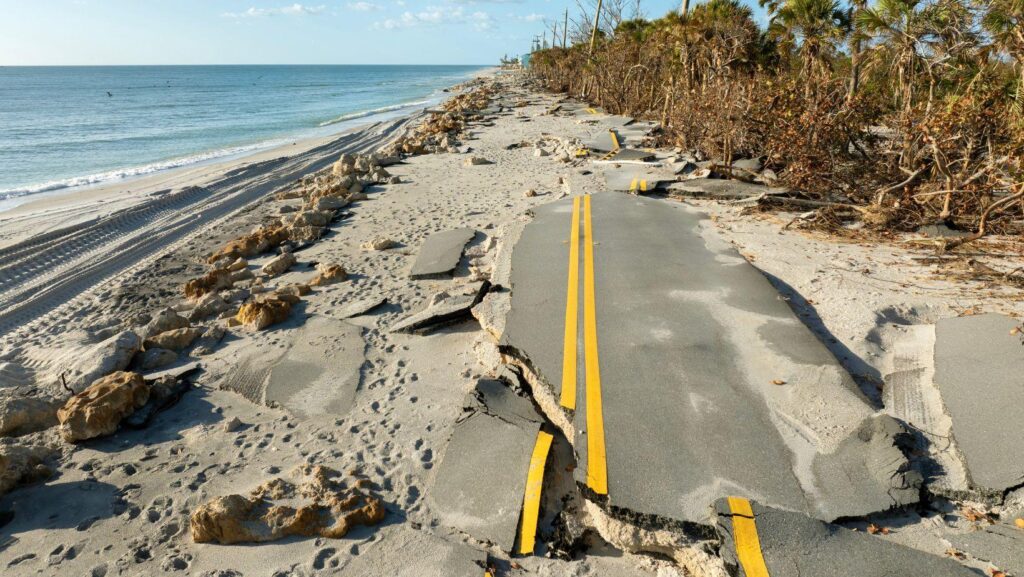
Designing infrastructure for extreme weather conditions requires practical solutions to reduce the risk of erosion. These conditions include:
-
High-velocity flows
-
Storm surges
-
Floods
-
Seasonal variations
These conditions can erode soil very rapidly and expose foundations.
Here, you cannot just stick to theory. You need physical systems on-site that stabilize ground conditions and control water energy—not just theoretical approaches.
Consider these tried and tested techniques:
Place rock bags to stabilize the ground
You can use rock bags in high-risk areas to preserve civil infrastructure from erosion. These are geotextile bags filled with rocks. They are positioned on:
-
Slopes
-
Riverbanks
-
Around foundations.
They adhere to the ground and form a stable protective layer. Position them where scour is most likely, such as:
-
At the toe of embankments
-
Around bridge piers
Their mass and flexibility enable them to remain stationary during high flows. They also slow down water velocity on the surface, which restricts soil displacement.
Use riprap to protect exposed surfaces
This is one of the most popular means of protecting slopes and shorelines. You lay large rocks on surfaces that absorb the energy of waves and flows. This technique is effective in coastal regions and fast-flowing rivers.
You are supposed to size the rock depending on the expected flow conditions. Larger rocks are needed in high-energy environments. They must be properly placed.
In addition, reduce the space between rocks to a minimum. This makes sure that water cannot find its way into the underlying soil.
Lay geotextiles underneath protection systems
Geotextiles act as a separation and filtration layer. You place them under rock bags or riprap. They prevent the soil from being washed away. Without this layer, water may erode small particles, weakening the structure.
The geotextiles that you use should be of high strength. They must be able to withstand load and pressure. This enhances the performance of the whole system and increases its longevity.
Construct revetments on the weak sides
These are sloping structures constructed along riverbanks or coastlines. They are constructed using:
-
Rock
-
Concrete units
-
Combined systems
Their purpose is to absorb and deflect water energy.
Revetments should be placed where there is continuous action of waves or currents. This prevents the further development of erosion inland.
Anchor protection systems in high-flow zones
Water speeds are usually very high during severe weather. You need to secure erosion control systems to prevent movement. This can include:
-
Anchoring rock bags
-
Tying systems together.
Focus on points where water moves faster, like:
-
Bends in streams
-
Narrow passages.
Correct anchoring guarantees that the protective measures are in place during peak conditions.
Strengthen the channels and drainage paths
Water tends to accumulate in certain directions. Especially during storms. You can strengthen channels using:
-
Rock lining
-
A modular system.
This regulates the flow direction of water. It minimizes the possibility of uncontrolled erosion.
Combine multiple systems
Last but not least, extreme conditions demand layered protection. You can combine approaches like:
-
Rock bags
-
Geotextiles
-
Riprap.
Every system serves a particular purpose.
This method enables you to solve erosion issues across different conditions. It enhances the resilience of the whole infrastructure.
×
×
